VeraCrypt
VeraCrypt is a powerful, open-source disk encryption tool that allows you to create, manage, and access encrypted volumes and containers, as well as encrypt entire disk partitions or storage devices. It is widely regarded as one of the most secure and reliable encryption solutions available, and is used by security professionals, journalists, and privacy-conscious individuals worldwide to protect sensitive data from unauthorized access.
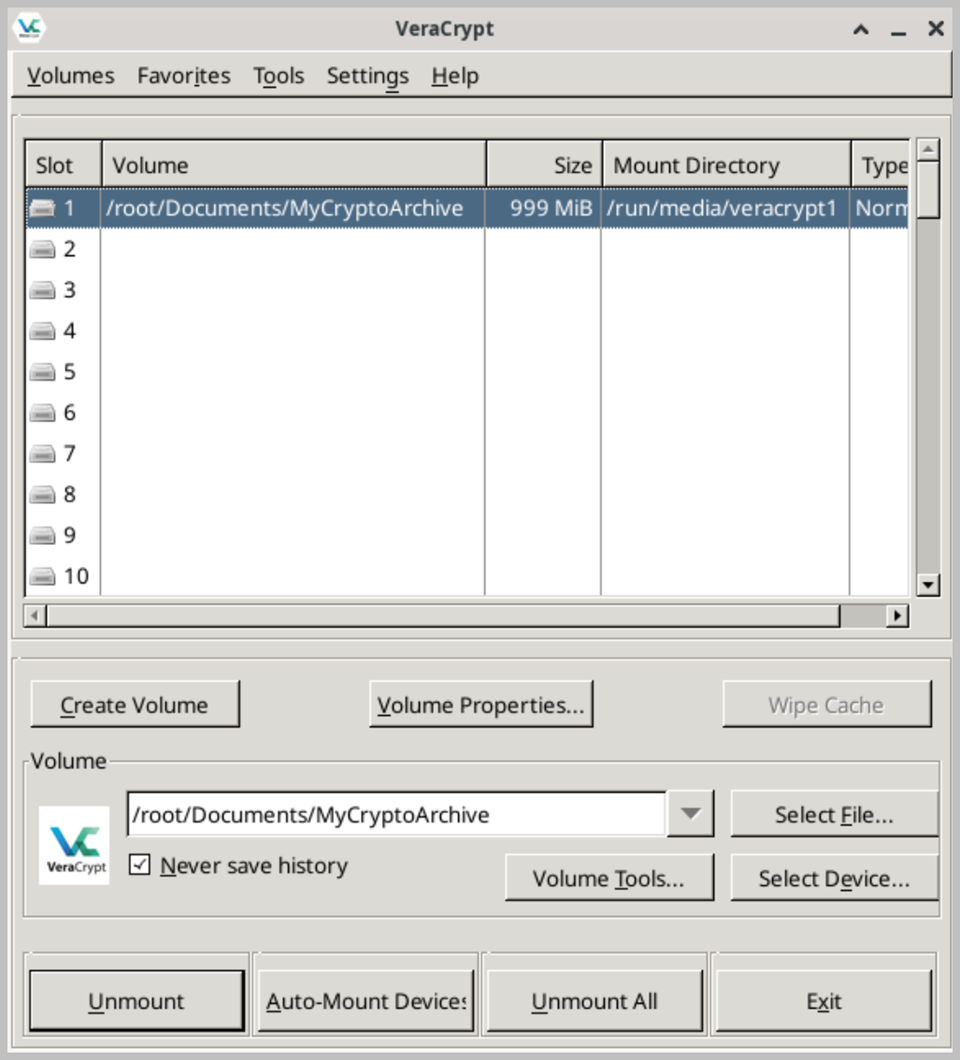
Within the Active@ LiveCD environment, VeraCrypt serves as the primary tool for working with encrypted storage. Since Active@ LiveCD operates independently of the host operating system, it provides a secure and isolated environment for mounting and accessing encrypted volumes without the risk of the host system logging keystrokes, caching decryption keys, or exposing sensitive data through swap files or memory dumps. This makes it particularly well suited for accessing encrypted drives on systems that may be compromised or unavailable.
VeraCrypt supports two primary methods of encryption. The first is the creation of encrypted file containers — virtual disk images stored as ordinary files on any drive or USB device. These containers can be mounted as virtual drives, making their contents appear as a regular file system that can be browsed, edited, and managed like any other drive. When the container is dismounted, all data within it remains fully encrypted and inaccessible without the correct password or encryption key. The second method involves encrypting entire partitions or physical storage devices, including USB flash drives and external hard drives, providing full-disk encryption that protects all data on the device at the hardware level.
VeraCrypt supports a wide range of industry-standard encryption algorithms, including AES, Serpent, and Twofish, as well as combinations of these algorithms for cascaded encryption that provides an additional layer of security. Hash algorithms such as SHA-512, SHA-256, and Whirlpool are used for key derivation, ensuring that the encryption keys generated from your password are cryptographically strong and resistant to brute-force attacks. The combination of strong algorithms and a high iteration count in the key derivation process makes VeraCrypt volumes extremely resistant to password cracking attempts.
Authentication is supported through passwords, keyfiles, or a combination of both. Keyfiles are additional files that must be present alongside the correct password in order to decrypt the volume, providing a form of two-factor authentication that significantly increases security. VeraCrypt also supports the creation of hidden volumes — a unique feature that allows a second encrypted volume to be concealed within the free space of an outer volume. This provides plausible deniability in situations where you may be compelled to reveal your encryption password, as the existence of the hidden volume cannot be proven without the correct hidden volume password.
When running Active@ LiveCD from a USB drive, all VeraCrypt settings and recently used volume paths are preserved between sessions, allowing you to quickly reconnect to your encrypted volumes the next time you launch the system.